
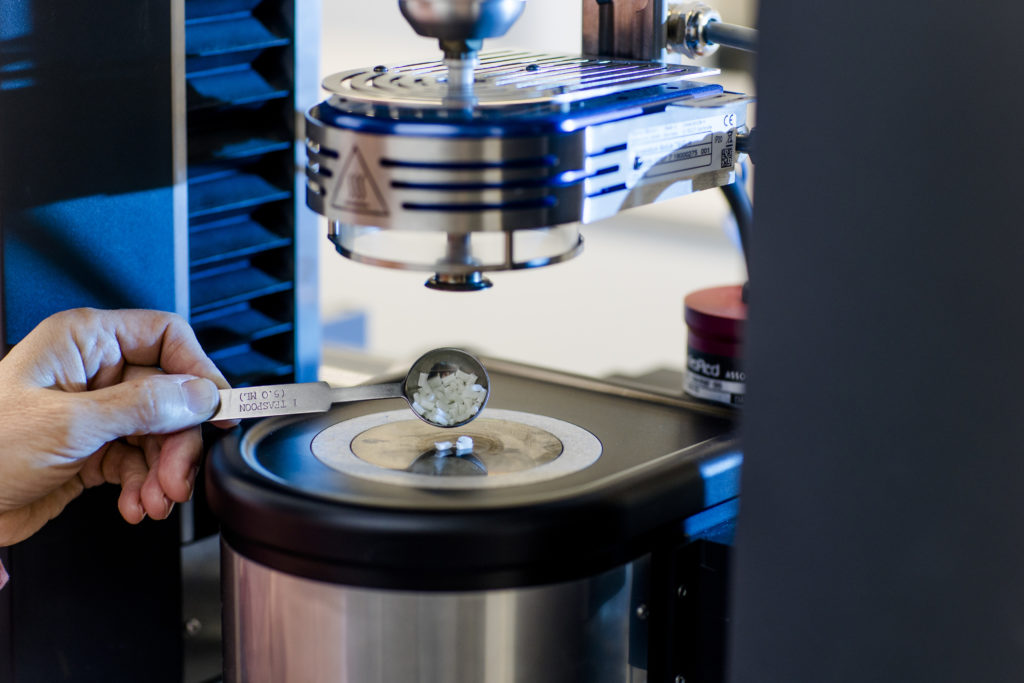
Physical and chemical properties of materials can be studied by using the existing analytical devices. The Institute of Polymer Technology has a wide range of measuring devices so that the materials can be fully characterized. The analytical measuring devices are listed as follows:
| Device / Method | Device Data | Testing Options |
|---|---|---|
| DSC / MDSC / OIT | Temperature range: -70 to 600 °C; Purge gases: nitrogen and oxygen | Determination of transition temperatures and enthalpies; Information about thermal history; DIN EN ISO 11357 |
| 3D-Calvet Calorimeter | Temperature range: 25 to 300 °C; Heating rates: 0.001 to 1 K/min | Determination of very small enthalpies with a resolution of 0.1 µW with a simultaneous sample volume of up to 12 ml |
| FDSC | Temperature range: -80 to 400 °C; Heating rates: 50 K/min to 20,000 K/s; Cooling rates: 5 K/min to 2,000 K/s; Purge gases: nitrogen and helium | Determination of transition temperatures under very high heating and cooling rates; Sample size approx. 10 to 1,000 µg |
| TMA | Temperature range: -60 to 400 °C; Load: 0.001 N to 2 N | Determination of the expansion behavior of solids as a function of temperature and time; DIN EN ISO 11359 |
| pvT | Temperature range: 50 to 380 °C; Cooling rates: 0.5 to 3 K/min; Load: 200 to 2500 bar | Determination of specific volume as a function of temperature, time, and pressure; ISO 17744 |
| TGA | Temperature range: RT to 1200 °C; Purge gases: nitrogen and oxygen | Determination of temperature- and time-dependent weight changes; DIN EN ISO 11358 |
| DMA | Temperature range: -120 to 400 °C; Load capacity: 35 N to 500 N | Determination of mechanical properties over temperature; Load types: torsion, tension, compression, shear, bending, media pot, optional DEA; DIN EN ISO 6721 |
| Thermal Conductivity | Temperature: 23 °C; Measuring range: 0.05 to 100 W/(m K); Min. sample thickness: 4 mm | Determination of thermal conductivity in solids using the HotDisk method; ISO/DIS 22007 |
| Temperature Conductivity | Temperature range: 25 to 300 °C; Measuring range: 0.01 to 400 mm²/s; Max. sample thickness: 4 mm | Determination of the thermal conductivity of solids; ISO/DIS 22007 |
| Device / Method | Device Data | Testing Options |
|---|---|---|
| MFR / MVR | Temperature range: 60 to 450 °C; Nominal load: 1 to 21.6 kg | Determination of the melt volume flow rate (MVR) and melt mass flow rate (MFR) of thermoplastics; DIN EN ISO 1133 |
| Rotational viscosimeter | Temperature range: 25 to 400 °C; Plate/plate, cone/plate systems | Investigation of the viscosity of liquids or melts in oscillation and rotation as a function of temperature and time; ISO 6721-10 |
| High-pressure capillary rheometer | Temperature range: 60 to 400 °C | Determination of the shear viscosity of melts under high shear rates using various capillary nozzles; Shark skin unit; Back pressure chamber; ISO 11443 |
| GDV | Temperature range: 60 to 400 °C | Determination of shear viscosity against a defined counterpressure |
| Ubbelohde solution viscosity | Temperature range: 20 to 150 °C | Determination of viscosity index; various plastic-specific standards (e.g., for PA, PE, PP, polyester) |
| Device / Method | Device Data | Testing Options |
|---|---|---|
| FTIR | Spectral range: MIR + NIR (600 cm⁻¹ to 12,000 cm⁻¹); Sample acquisition: Transmission, ATR diamond + germanium, microscope, diffuse reflection, hot stage | Identification of polymers; DIN EN 1767 and DIN 55673 |
| UV/VIS | ZwDual-beam spectrometer; 200-900 nm, 23 °C | |
| Abbe refractometer | Measurement range nD: 1.30 to 1.72; Light-emitting diode with 589 nm | Determination of the refractive index of opaque or transparent liquids or solids |
| Optical particle size measuring device | Particle sizes 10 µm to max. 2 mm; Dry dispersion; max. particle count ~ 100,000 | Determination of various geometric parameters of particles and their distribution using optical images |
| Surface Tension | Contact angle measurement; Hanging drop; Stamp method with heating table up to 350 °C | Determination of the surface tension of solids and liquids; Determination of the surface tension of melts using the stamp method |
| Karl-Fischer Titration | Temperature range: 60 to 300 °C; Purge gas: Nitrogen | Determination of the water content of solids |
| Incineration | Microwave oven; Temperature range: 60 to 600 °C | |
| Porosity Measurement | Buoyancy method | Determination of density according to Archimedes’ principle using an analytical balance; Gas pycnometer; Gradient tube; DIN EN ISO 1183 |
| Gloss and Color Measurement | 20°, 60°, 85° – tungsten lamp; 45°/0° – standard light D65, 400 to 700 nm | Determination of gloss and color characteristics on solid surfaces; DIN 5033 |
| Device / Method | Device Data | Testing Options |
|---|---|---|
| High-resistance measurement | Ring electrode; Temperature range: 23 °C; Measuring voltage: 1 V to 500 V | |
| Low-resistance measurement | 4-pole electrode; Temperature range: 23 °C; Measuring current: 1 A to 1 µA |
Dipl.-Ing. (FH) Gabriela Riedel
Head of Testing Laboratories
Institute of Polymer Technology
- Phone number: +49 9131 85-71069
- Email: gabriela.riedel@fau.de